


Spiti Winter Safari – Shimla to Shimla

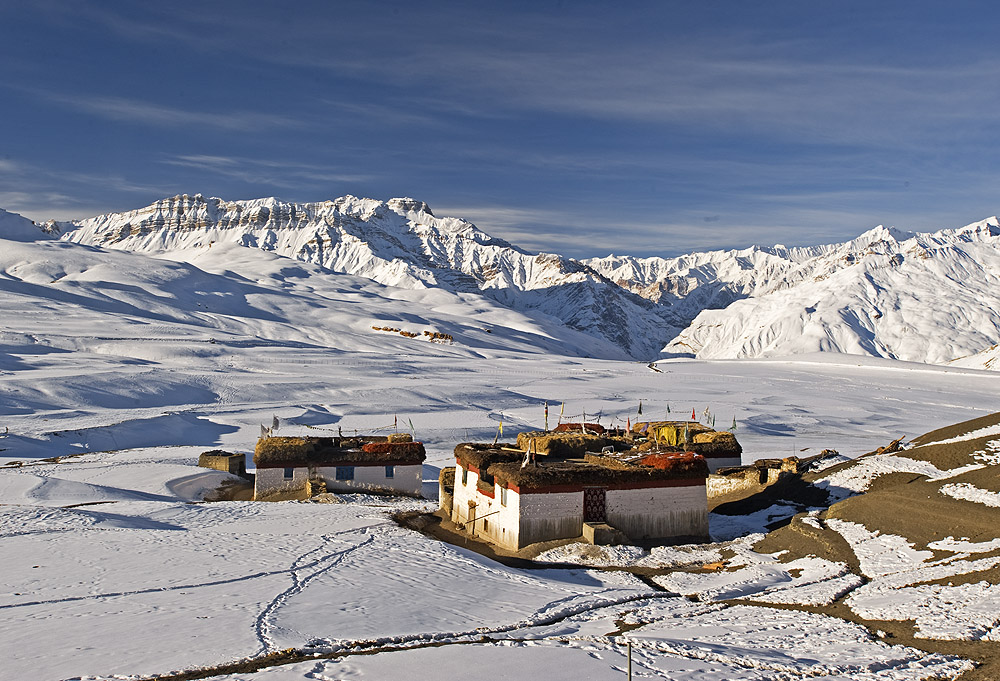
Winters in Spiti
Overview
A tour to experience the best of Himalayan Winters, culture and tradition. From foothills to high mountains, from pine forests to cold desert – this tour takes you through the heart of Kinnaur district before continuing to the highlands of Spiti Valley. Experience winter snowfall and subzero temperatures in a land where everything is frozen for few months. Along the journey you will witness – high roads, ancient temples, monasteries, dangerous roads, deep gorges, snow mountains, pine forests, vast riverbeds, high altitude villages and the most amazing people.
Highlights
5. Enjoyable short trek – Dhankar Lake
Detailed Itinerary
Day 1 – Shimla to Sangla
We pick you up bus stand at Shimla and so our trip begins. The drive takes you over the hills of the Shimla district through the towns of Kufri and Narkanda. After the initial dash over the hills, the road descends down to the Sutlej valley as we continue to the town of Rampur on the southern bank. The roads are carved on vertical rock faces at several locations giving itself a distinct identity. This road is popularly known as Indo-Tibet Highway. You’ll be welcomed by several hydroelectric power projects as you enter Kinnaur district, the major one at Karcham where a dam is built at the confluence of Baspa and Sutlej rivers. From Karcham we cross over the bridge and enter Baspa Valley to head towards Sangla, the overnight halt.
Day 2 – Sangla to Tabo
Today is the day where we enter the Spiti Valley. We leave Sangla and return to Indo-Tibet highway at Karcham and continue upstream of Sutlej river till Khab, the confluence of Spiti and Sutlej. We leave Sutlej behind and continue upstream of Spiti. Suddenly you can see the landscape has transformed with barren mountains all around. After an hour’s climb we reach Nako, another little village situated at an altitude of 3800m. The main attraction of this village is the artificial lake, which in the late spring is a sight to behold with pink flowers bloom all around the lake. After a brief stop at the lake we descend down to the river bed and continue upstream of Spiti crossing several villages – Chango, Shalkar, Sumdo, Hurling; before we enter the town of Tabo. Chos Khor Gompa is a 1020 year monastery located in the quaint village of Tabo. The monastery is one of the most ornately decorated depicting the life of the Buddha Pantheon covering its entire walls. You can spend enough time here talking to the monks trying to understand what a thangka painting is. Spend your day relaxing in the fields of Tabo or hike up to the caves, the monks used to meditate. Overnight stay at Tabo.
Day 3 – Tabo to Dhankar, Lhalung to Kaza
Today we take the road to Kaza till we reach Sichling village, from here the road winds up to the Dhangkar monastery, which was once the capital of Spiti, under King’s rule. Dhang means cliff and kar means fort, the fort situated on the edge of a cliff. Dhangkar Gompa or monastery is one of the architectural master pieces of the Buddhist yore. Built 800 years ago this is one of the endangered archeological sites in the world. Experience the old world feeling of the Dhangkar monastery. An hour and half hike takes you the beautiful Dhankar lake, relax and click as many photos on the shores of this beautiful lake before heading back to the village. From Dhangkar we drive towards one of the little know villages of Spiti, Lhalung. With Snow capped peaks in the background and the cultivation fields built on the slope of the mountain Lhalung is a photographer’s charm. Golden Temple or the Serkhong Gompa is another 1020 year old monastery adorning this little village. From here we head to Kaza, the administrative headquarters of Spiti for overnight stay.
Day 4 – Kaza to Kee, Kibber, Gette to Kaza
We leave Kaza and head to the most famous monastery of Spiti at Kee. Known commonly as the Kee Gompa, the monastery looks like a pyramid of houses, built on top of a hill. Enjoy the tasty cup of tea served by the monks as you walk through the maze of Shrines. From here we drive to the village of Kibber to witness one of the masterpieces of modern construction – Kibber Chicham bridge built up on the gorge at a height of 4300m. After a short photo session, we head to Gette, a viewpoint to see the beauty of Kee monastery with Spiti river in the background. Return back to Kaza for overnight stay.
Day 5 – Kaza to Hikkim, Komic to Langza
High on Himalayas is the theme of the day. We leave Kaza and immediately gain altitude as we head towards the village of Komic – the highest village in the world with a motorable road at a height of 4580m. Tangyud Gompa (Monastery) is the jewel of the place. The old and new monastery shows the devout Buddhist beliefs of the locals. We retrace the path towards Hikkim, situated at 4440m this village boasts the presence of Highest Post Office in the World. Send postcards to your family and friends from here. The road continuously meanders above 4400m till you reach the village of Langza, with the Snow Capped peaks jutting out in front of you in every corner leaving you breathless with its sheer magnitude. Our overnight stay is at Langza, the most scenic village of Spiti, situated under the shadows of 6303m peak called Mt. Chau Chau Khang Nilda and adorned by the large statue of Buddha.
Day 6 – Langza to Kalpa
We start our journey back towards the bigger cities but not without a final blast, not without witnessing the beauty of Himalayas for one more time at Kalpa. Kalpa is a little village above the town of Recong Peo, it offers one of the most magnificent views of snowcapped peaks called the Kinner Kailash range, winter abode of Lord Shiva. The mountain is deeply worshipped by the locals. Every year in the month of August several pilgrims scale the peak of Kinner Kailash to worship a 70ft rock which stands out from the rest. Kalpa is a great place to see the entire range.
Day 7 – Kalpa to Shimla
Last day of the trip, we leave to Shimla after witnessing the beautiful sunrise against Kinner Kailash. As your minds wander back to the lives that lay ahead we bid goodbye to you at Manali, with the breathtaking visuals of the last week leaving you wanting for more.
Starts from INR 17500 per person* for a group of 6 people
Cost includes
- Transport – Innova / Xylo / Scorpio – 7 Days -Driver charges, fuel charges, toll and parking charges
- Accommodation – 6 nights – double sharing with breakfast and dinner – MAP
Cost excludes
- Accommodation at Shimla and Manali – Can be arranged at extra cost
- A/C in taxi – can be provided at additional cost
- Personal expenses
- Lunch on all days
- *GST 5%
- Cost incurred due to change in itinerary due to landslides, roadblocks or factors beyond human control
- Anything not mentioned in the inclusions list above
Note: Homestays will have shared bathrooms


